Blog

  • Mountainscape: Learning to Ski in the Swiss Alps

    Mountainscape: Learning to Ski in the Swiss Alps

    Susan Riva

    La Tzoumaz is in the heart of the 4-Valley ski region in the Swiss Alps. The Swiss Ski School welcomes skiers from around the world, offering ski and snowboard lessons. The ski school also trains young skiers to become ski instructors. This learning organization teaches skiing in the heart of a beautiful Alpine Mountainscape. 

    I have raised my children in the Alps where our family has been part of the ongoing tradition of down-hill skiing. All of our five children are certified ski instructors and have participated on regional ski-racing teams. Not only did I teach my children to ski, but I enjoyed teaching beginners while my children were young. Ski teachers adapt to their natural environment where the classroom is the Alpine Mountainscape. Intercultural relations are another important dimension of this learning organization where instructors speak multiple languages to tourists who come from around the world to enjoy the excellent slopes. 

    We celebrated the 50th anniversary of the ski school in 2019. Political representatives and ski instructors that had taught over the years all came to enjoy ski races and food served on the ski slopes from the ski bar made of snow. We were celebrating more than just the ski school, but a way of life.

    Here is a video of this season’s ski instructors following the medal ceremony that takes place each Friday at 17:30 on the ice-skating rink in the center of the village. Students can work at the ski school and become ski instructor apprentices, developing multiple skills to teach skiing. Though it is important to know how to ski and snowboard well, it is also important to know how to develop good relationships with the clientele and provide a safe experience. Language skills are also essential. Most instructors speak French, German, and English.

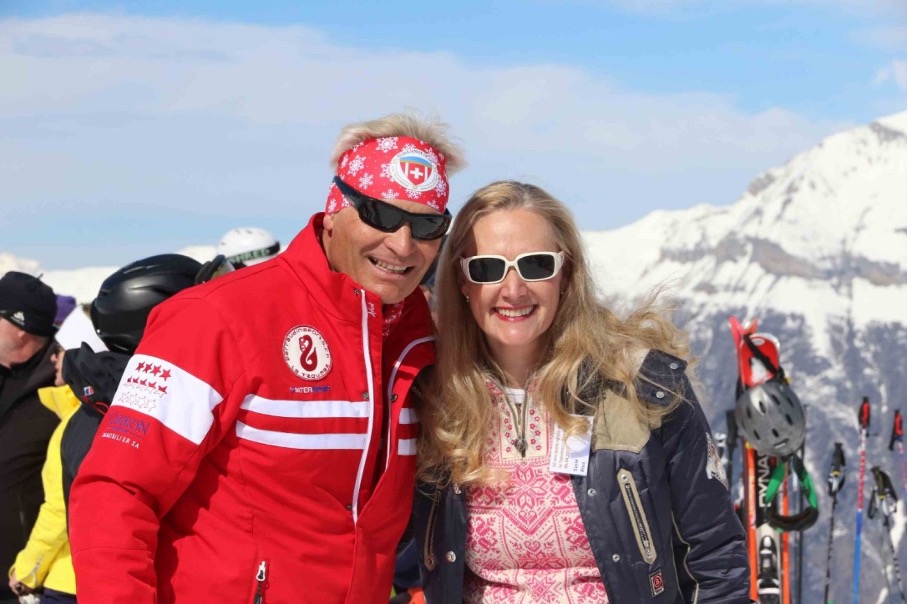
    My husband, Angelo Riva, has been director of the Swiss Ski School since 1986. After he ended his racing career as a down-hill and giant slalom racer, he became a Professor of Skiing. He was chosen to be an expert and a member of the Swiss Demonstration Team. He has carried on the tradition, passing on his passion to our children. Here is a picture of the 2023 demonstration team that our sons participate on together.

  • Landscapes of writing jewelleries by the ocean 

    Landscapes of writing jewelleries by the ocean 

    Berit Bareksten, sociologist at HVL, Western Norway University of Applied Sciences

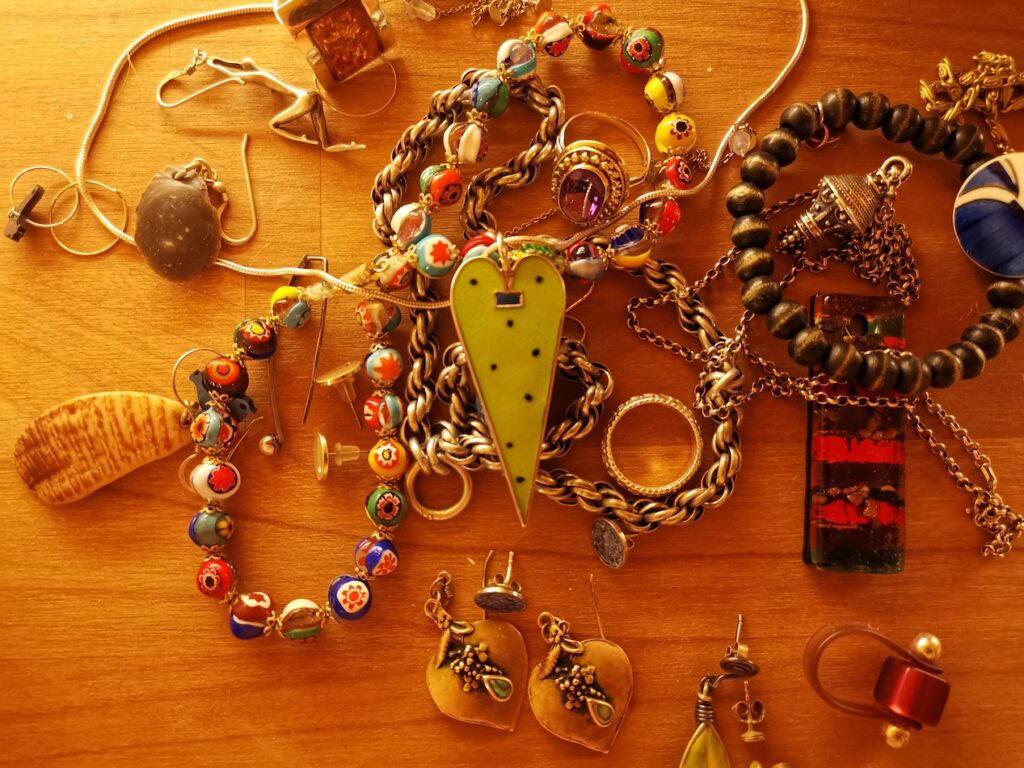
    Jewellery in memory of beloved ones. My totally black bracelet, a gift from three of my friends – one of them dead already. She wasn’t ready to die from us. She had just moved into her new language of love – Italian. She became one of the most beloved teachers ever. It’s true. All of what I’m writing here is true. Moving into landscapes of burning memories, trying to redemptive some of both my errors and my griefs by writing them. Errors follows in the paths of intensely sorrows. There have been like this for such a long time. You must believe and go further with me. I like to give away some of my jewelleries, looking down onto my shelter – a shelter for to hide from the world, while feeling weak and crackling. I wrap those memories around me like textile coverings, feeling warmer than in the early morning. I woke up with a slightly felt headache, and slowly went out of my bed. Trying to think of something else than dead. It’s not easy. You must believe this and go further with me. My thoughts are occupied with those who are going to die. It’s everyone, you say, disturbing me while trying to give this upcoming day a chance to still become a good one. The sentence: It is sad, is the only one occupying my body and my head, being a part of my body. The sadness is all over, and I wanted that specific sadness to be a beautiful one, with colours and music, she said. I want you to put colours on in my funeral, she told me, last Friday. I was there on what should have been a normal day at work. But nothing is normal and synchronised with the rest of the world – not for her, not for me. I’m in a limbo, try to establish something for real in this trembling times, filled with anxiety, hope and work to do. Doing well, still feeling locked out from the belonging of colleges. Being in-between as those suffering from diseases. So, that’s why: This in-between is my place of true belonging. Belonging in the texts, and with my colleges-students doing creative academic writing with them, because I’m quite good at it. Reading my beloved death ones, (as Hélène Cixous also does) and those of my friends followed the same path of death. As the death is a kind of a narrow path deep into well-known forests, or alongside the rivers – or by the seaside with the whole ocean taking part in my sadness. Tears overwhelming fits with the ongoing, moving, flowing water. Disappearing. Drowned. Dying. Taken away, melting into something huger than me. That’s why I must live by the sea, you see? It’s not easy. You must believe the oceans capacity and go further with me. Wittgenstein came to my mind. In some of his fragmented notes he writes:

    “The thought is already worn out and can no longer be used. (A lingering remark I once heard from Labor regarding ideas in music.) Such silver paper that is once crumpled up does not kang lattes all the way back out. Almost all my thoughts are a little crumpled.” (1995, p. 50. My own translation from Norwegian).

    And he is so right about the art of being able to write creatively, when he says about his thoughts, his pencil, and his writing hand: “I actually think with the pen, because my head often knows nothing about what my hand writes.” (1995, p. 50. My own translation from Norwegian). 

    So, the jewelleries then. What about them? Stones and scallops made by friends long ago, some golden earrings, more in silver og those hearts made of brass (like music!) will always be a part of me in memories of the child born to this world, unplanned but truly loved from the first moment. The silver hearts are in my ears right now, because I will meet up with my friend who gave them to me, years ago. The green heart around my neck is from her without much more time to live. Her timescape is about to running out of time. The never-coming-back will be her escape from the world, not willing to that escape – neither her, nor we. Her beloved ones, for all of us it’s much too early to leave. The ocean drowned my screams in its tremendous beauty. But her gift, the green heart is coloured by her, in life and in the landscapes of the dead. 

  • Performing Eco-Recovery: A Trial Run in Our Skins

    Performing Eco-Recovery: A Trial Run in Our Skins

    Dr Alice Charlotte Bell  (Senior Lecturer in Fine Art, University of Lincoln)

    In 2022 the artistic partnership, Fossey+Bell, Dr. Steve Fossey and Dr. Alice Bell; artists, practice-researchers and educators at the University of Lincoln, undertook a research experiment. Methodologically, we used artistic multidisciplinary approaches to immerse ourselves in a landscape undergoing a process of rewilding. As researchers we sought to unearth questions and find answers through wandering, dwelling, and ambling within an estate for extended periods of time. As scholars we sought to involve our students in a pedagogic process. As creative practitioners we invited spontaneous encounters with human, animal, mineral, vegetable with our entire beings. Funded by the Natural Environmental Research Council (NERC, UKRI, as part of a bigger investigative project), we sought to illuminate biological, historical, political, ecological and poetic connections, documenting our perceptions and interactions. 

    Our investigative practice-research methodology saw us take photographs, videos, collect objects, conversations, and audio. Our embodied multimodal process made clear the complexities of such a site and the politics of power, ownership and authorship within the construction of new rewilding narratives. Indeed, our artistic responses, at times, contested and provoked expectations of the artist’s place in the greater politics of climate debate and institutional power.  Moments of transgression became necessary interventions and, unexpectedly, opened the way for us to move forward.

    To progress, we took the more immediately digestible creative stimuli forward and next utilised Lois Weaver’s Long Table format to invite publics to share a meal with us (made from foraged and locally-grow ingredients from the land). Along with several students (as co-producers-researchers-creatives) we invited participants to consider their own engagement and relationship with the site as potential acts of eco-recovery. Over food, we shared individual responses to questions of climate responsibility, blame, liability, victimhood, justice – themes stimulated by various multi-sensory and artistic artefacts from the land.  Together we considered the experience of the place and its emotional and physical effect on our wellbeing and senses of self, foregrounding the notion that a reciprocal relationship of recovery was at play: people and place working together to explore through creative currency; a process of eco-recovery. All conversations were recorded, the tablecloth notated, photographs and video taken.

    Following our communal feast, Fossey+Bell assimilated all material gathered and produced artistic responses to the encounters experienced personally, as a duo-collective and with the sites inhabitant’s animal, mineral, vegetable. A Trial Run in Our Skins, became a multimodal exhibition that included, sculpture, clothing, projections, vegetables, performance, video, and audio works. It was a living laboratory of time-based, living, dying, and reoccurring expressions. It comprised pedagogical, ethical, aesthetic, and sensory thinking, with the intention of finding forms that might in time make the climate discussion accessible to a broader spectrum of contributors. Indeed, our playful, relational, experimental, and multi-disciplinary modes of engagement are allowing us to open a more inclusive ongoing conversation with academics, audiences, and other interested parties.  Our conversations are dialogical spaces whereby we all become interlocutors whose participation is necessary in understanding how lived experiences and shared his/erstories can create new blueprints for urgent change.

    www.alicecharlottebell.com

    www.stevefossey.co.uk

  • Space on St Valentine’s Day*

    Space on St Valentine’s Day*

    Peter Leyland

    During our discussion about space on the 13th of February, I thought about the metaphysical concept of the microcosm and the macrocosm which features in many of John Donne’s great poems. Here are two verses from two very different poems, The Good Morrow and A Valediction of Weeping, which could be appropriate today.

    “And now good morrow to our waking soules
    Which watch not one another out of feare;
    For love, all love of other sights controules,
    And makes on little room an every where.
    Let sea-discoverers to new worlds have gone,
    Let Maps to others, worlds on worlds have showne,
    Let us possesse one world, each hath one and is one.”
    

    Donne is clearly using the idea that lovers are everything to each other but in bringing in the geographical metaphors he makes it into a more universal statement.

                        “On a round ball
    A workeman that hath copies by can lay
    An Europe, Afrique, and an Asia,
    And quickly make that which was nothing, All:
                         So doth each teare,
                         Which thee doth weare,
    A globe, yea world by that impression grow,
    Till thy teares mixt with mine doe overflow
    This world, by waters sent forth from thee. my heaven dissolved
           so.”
    

    Similarly, after an argument it is as if the whole world has ended…

    *Spellings and spacing from The Nonesuch Donne (1929) 

  • Struggle of humanity 

    Struggle of humanity 

    An echo of, and a dialogue with Hélène Cixous, on her writing about temporality, time, and poetry
    Or: “to write in the absent of the author?”, according to Cixous)

    Berit Bareksten, sociologist at HVL, Western Norway University of Applied Sciences

    My old grandfather clock woke me up this morning. Told me to meet this new day, and to write. It’s dark outside, although and at the same time I recognised the darkness, I’m looking into the light of Venice, on my computer. Unlocking it by keying the name of one of my cities in UK, simultaneously I’m also there, in Italy.  Although it’s about being here, practising. Words in another foreign language are here with me, I’m thinking. Listening to friends in their own broken English. It’s good enough. It’s understandable. It will come, and some will stay, and expanding both words and meanings, while reading. While writing. Like mice crawling, they are sweety ones but irritating. Sitting there for just a short time, and then they are gone. Coming back and gone again. Unlike mice I like those words to stay, be part of me. I’m checking how to spell them properly. Mixing some letters – as I do in my own language. Nothing new under the sun, so to say.

    The French philosopher and feminist has for a long time been a name, but nothing more for me. This last week I found an essay written by Hélène Cixous (yes, I wrote her surname correct!) about volleys. Volleys of humanity, and I printed it. Started to read. The language is so smooth, so inviting. Feeling warm inside. Like pebbles on the beach, affected of words beneath my hands and between my fingers. Tasting them, looking into them, listening deeply. While writing, listening. Trying to taste the words before typing them – or tasting at the same time as typing. By chance they come to my mind, and from time to time they felt for staying. I welcome them. 

    Volleys, I wonder. What does she mean, I ask myself. Stay in the text, recognise the water coming between and together with those pebbles, on that specific beach – in this inviting text. I’m telling you that they are reaching my toes now. I’m walking into the landscape of wondering and misunderstandings. Moving toes on pebbles and taste the words in my mouth. Still not hurts. Smooth. Smiling sentences, I say to myself. Continuing reading. I’m still invited, but the feeling of being a child seeking care and clarity from the adults around me is still there.     

    I’m reading her while my cat is on my lap, as she is writing her essay on a sheath of paper between, her two cats. I just read it. And she’s even saying that she would like to tell Jacques Derrida about those two cats, as he knew them, she writes. The essay is about humanity, but also about hum-animal beings (Cixous remember us about that she is, also a cat). Posthumanism: Thinking, re-thinking, make the world of humanity more holistic. I continue reading. It’s starts with humanity; it ends with humanity. A word worth six billion, she says – and I agree.

    Her essay is an ongoing dialogue under the gaze of those passed away, but still here – in their texts, in their thoughts. As Jaurés, and Derrida. But also, about them with other forerunners, under gaze of even older thinkers and writers. She listening to them, and they’re listening as well, both to her and those back in history. Derrida insisted on the living-dead relation, Cixous says in her essay. She, herself speaks about the friend“[…], for the friend is always internal, the human beings lodges the friend, he is inhabited, haunted, we listen, the internal friend listen to us think, before we have ventured to speak. We shelter, we share a same psychic space. On the one hand, everything we think is online, internally.” (2011: p. 268).  The theme they are looking at, and have their dialogue upon, is the idea of the magic word Humanity. Cixous is, in her text, inspired from the newspapers name in France: Humanité. Jaurés, and Derrida, invites us to join them in the dialogue, not only about the newspaper’s name, but rather about the idea or figure of ‘Humanity’. What this distant word ‘Humanity’ (among other words as Justice, Truth), from Latin, means to us – today. Cixous speaks further on with both Kant, Shakespeare, and Rousseau, in her essay – asking them about Humanity. Their answering differs in both lifescapes and timescapes.

    Jaurés created the newspaper, and Cixous writes: “I try to imagine who provided the maternal kiss to Jaurés. What beautiful face was the secret of his strength?” (2011: p. 282). She kind of answering with a story about her own crying mother, or maybe there is the cat crying. Echoing friends as Piotr Rawicz and his wife Anna – survivors from Auschwitz. With the voice of ageless humanity: “Mama! Oh my god! Mama! Help!” (2011: p. 282).

    Looking from a distance, I’m thinking of Ukraine, of women in Iran and Afghanistan, among others: The world is in enormous need of volleys of humanity – or the idea or the figure of it. Dialogues, not tanks, and weapons. Understanding, not misunderstanding. Peace not war. Life instead of death. Castles, towers and defending installations built of sand on beaches, with children, instead of real defences between people and countries. Listening into care of humanity. I have a dream. Imagine.

    The grandfather’s clock on the wall remains me of time passing by. Dear dead-ones living here still in their sounds from the clock and from the silent of voices. Thanks to Hélène Cixous showing me her ways of thinking of the world through those not-longer-here, and how they still influence us in our thinking, writing and being. Shaping us as human beings and citizens in the world.

    “We are so temporary. I think of my brief grandfather Michael Klein who died a German corporal at age thirty-six in 1916 on the front in Belorussia, for ideas that were morally very great and that would all turn out historically false. I don’t know under whose gaze he signed up, a volunteer as a German Jew, although father of a family but perhaps it was under the gaze of Captain Dreyfus as much as under the gaze of the Kaiser before whom he wanted to defend a Jewish citizen’s loyalty. The poor man, he wants to prove that one can be Jewish and no less a good German, and even, oh horror, a better one.”
    (Cixous 2011: p. 268)	
    

    And her beautiful, insightful, and important essay is worth reading, I will say. Sentences as waves of eternity. Without, in this text, taking notice of her reflections on feminism according to mankind and humanity (my highlighting). And about mothers weeping. Or to even not go deeper into her poetry parts. Next time.

    I quote her here, in the end of my text, with her beginning of Volleys of Humanity:

    “We are reading, in the morning as soon as it is day, we read – from the cradle, from the first gaze we already want to belong to a gaze and fall under a gaze, already we are reading. We are giving ourselves to (be) read. We are making links. We are mirroring ourselves in the mirror of the other. Is this the beginning of being human?”
    (Cixous 2011: p. 264)

    *In the free dictionary I read the meaning number two of ‘volleys’:
    2. A group of remarks,expressions, or actionsdirectedtoward a certainrecipient or audience:a volley of oaths; a volley of laughter.”

  • Time, place, and personhood in liminal spaces

    Time, place, and personhood in liminal spaces

    Helen Woodley (Assistant Professor, Northumbria University)

    I started playing Dungeons and Dragons during Lockdown. I was a relatively late joiner to the world of tabletop role playing games (TRPG) and I have to admit I was partly influenced by the Netflix series Stranger Things. I was also deeply influenced by Gadamer’s concept of a shared horizon and the use of liminal spaces which can create opportunities for dialogue so that we move away from solely considering our own perspective. Lockdown had felt so isolating on so many levels and playing a TRPG seemed like a way I could travel (albeit in a theatre of the mind), have meaningful interactions with others, and experience a different way of being ‘me’ for a few precious hours each week. 

    The community of players I found slowly moved from acquaintances to friendships and the feelings of acceptance and safety allowed me to gradually develop my character from a generic 2D ‘person’ into someone more multifaceted and alive. Players have many reasons for creating the characters they do but they are all linked to self and identity one way or another. Some players may create a copy of themselves whereas others might want to play an idealised version of who they are. Whatever their motivation, the characters they create become deeply personal and have their own life history and narrative voice. 

    My character, Brogh, was really a doppelganger of my own perspective of my academic identity. Playing Brogh as a white cis male was born out of reflections that the academy is often a landscape where people like that thrive and often dominate. It was an acceptance that, in my real academic  world, I often choose to act in the ways I perceive a white cis male would especially when I am in a leadership role. Brogh resembled my academic identity in other ways too. He would appear confident and take a leading role but inwardly feel insecure and uncertain of how he was perceived by others. He often saw a straightforward solution to a problem but became frustrated when others did not readily agree to the course of action he desired. I therefore used Brogh as a way of exploring how I would approach situations in my academic world, especially how my actions were perceived by others, and play around with how I might act or think at different points in time. 

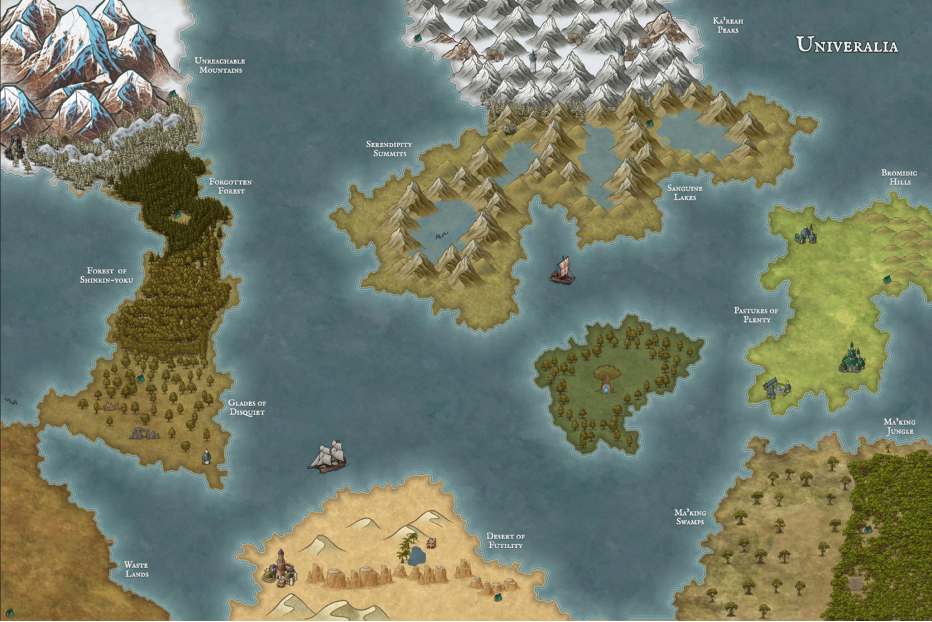
    All of this took place in a liminal space created by the other players. Time in this space was elastic and could be stretched or compacted at will. But this space was also deeply grounded in a sense of place. The world which we acted in was both stunningly beautiful and unbearably harsh. The use of maps was key to creating this sense of a real place and it is the use of TRPG maps alongside a developed character that currently fascinates me. I am currently playing with how to map out my academic world in a meaningful way and how that landscape can be used to develop my academic identity in a timescape outside of my physical experience. I feel that this has been beneficial for my own development but am uncertain how, or even ‘if’, it has a wider application. 

    • Influences:
    • Bowman, Sarah Lynne. 2010. The functions of role-playing games: How participants create community, solve problems, and explore identity. McFarland.
    • Ekman, Stefan. 2013. Here be dragons: Exploring fantasy maps and settings. Wesleyan University Press. 
    • Gadamer, Hans-Georg. 2013. Truth and Method. A&C Black.
    • Kolb, Alice Y, and Kolb, David A. 2010. ‘Learning to play, playing to learn: A case study of ludic learning space’. Journal of Organizational Change Management. 
  • Buddyscapes #2

    Buddyscapes #2

    Silvia Luraschi (Adult Educator & Independent researcher collaborator, University of Milano Bicocca) and
    Tom Troppe (PhD Student, Canterbury Christ Church University

    Horizon for a new vision: interdependence in Adult Education

    In recent dialogues, we have gone beyond sharing experiences as we described in Buddyscapes #1. Our sharing has taken on new purpose as research: to reflexively interpret this sharing of our experiences. Just as our individual landscapes differ, so do our theoretical frameworks.

    Silvia:

    Buddyscapes is an ongoing “transnational” research project conducted by two researchers – a woman, and a man with dissimilar backgrounds and diverse age – that are living in different countries: Italy (Silvia) and UK/USA (Tom).

    Chatting and sharing pictures by WhatsApp represents a cross-borders experience where the researchers are involving interactions across the nation-states’ borders. For Silvia this process has created a space for dialogue around the interdependence between humans and the more-than-human world and what the systemic thinkers called co-dependency links (Maturana and Varela, 1980). Looking at photographs taken for each other has over the months created a kind of bond.

    Photo by Luraschi

    According to the feminist bell hooks “we can celebrate and honour communitarianism and interdependence […] by affirming our connection to the world community on a daily basis.” (2022, p. 124 Silvia’s translation from the Italian version of All about love, 2001). But how is it done? The author suggests that in order to make choices that affirm our interconnectedness with others, it is necessary to hone one’s awareness–that is, to cultivate one’s capacity for critical analysis that enables one to understand how to care for oneself and others with commitment, trust, responsibility, and respect, and to always be willing to learn.

    Tom:

    In describing methods of critical educational research, Cohen et al (2017, p. 53) cites Gadamer’s (1975, p. 273) thinking that it is ‘the fusion of horizons between participants’ which is the foundation of such emancipatory research. Similarly, Laverty (2003, p. 21) quotes Koch (1995, p. 835): 

    Hermeneutics invites participants into an ongoing conversation, but does not provide a set methodology. Understanding occurs through a fusion of horizons which is a dialectic between the pre-understandings of the research process, the interpretive framework and the sources of information.
    Photo by Troppe

    In The Beautiful Risk of Education, responsibility is conceived as occurring in the events in which ‘I am a non-interchangeable I’ (Levinas 1985, p. 101, cited by Biesta 2013, p. 21). Within the scope of this project, such irreplaceability is demonstrated for me in Silvia’s unique position, which she reveals in her photographs. No one else is standing in her situation—temporal, spatial and axiological (Holquist 2002, p. 152). Each photo is a documentation of her irreplaceable place, drawing on all her experience, her judgement—what Biesta calls her virtuosity, discoverable especially ‘through life history’ (Biesta 2013, p. 136). By her giving this to me—and, in return, my giving her my situation—there opens up the opportunity of a shared horizon, of directing our gaze in a mutually gifted direction.

  • Reflecting on Timescapes through books

    Reflecting on Timescapes through books

    Peter Leyland

    A recent life event has made me think that Time is cyclical rather than linear. The event was the reunion of a group of friends from my sixth form days in Liverpool when the city was alive with creativity in art, music, poetry and ideas that the future was full of infinite possibility if only we could grasp it. We had taken a photograph then, and astonishingly 50 years later had taken the photograph again in the same place. There were one or two gaps for those with whom we had lost touch. 

    As a literary scholar I am drawn to ideas of Time explored in poems and plays by writers like T.S. Eliot, and J. B. Priestly, the socialist and pacifist; and in a post-modernist novel like Slaughterhouse-Five, where linear Time is disrupted by war. Personal experience too has made me aware that linear Time can become distorted by events

    Eliot’s view of Time is shown in Burnt Norton where he expresses the concept that time present time past and time future are all contained within each other, but what does that actually mean? As a reader of his poetry and its application to my own life as mentioned I can relate it to the idea that Time is cyclical, that events can be seen to repeat themselves. In a song called Deja Vu a band sing, ‘It makes me wonder what’s going on, down under the ground?’

    What is going on? Some years ago, I experienced the sudden loss of two people in my life causing Time to lose all sense, all structure and all meaning. I consulted Locke’s Essay on Human Understanding and found him talking about ideas of succession and duration. Locke related this to the specific motion of the earth around the sun, and later in the book discussed a mother’s grief about the death of her child in relation to Time, and how long it would take for her to recover. 

    Although I had no  experience of the death of a child, this connected with me and in furtherance of my teacher training I began to plan a project on the subject of Time itself with a class of 11-12 year olds. I asked them time related questions about how early man became aware of the passage of time, how our bodies are a kind of clock, and how time could be measured? From a range of experiments that they did in groups a number of conclusions emerged. One read: ‘A water clock measures times of hours and minutes and is a bowl of water with a hole at the bottom. When the water leaks out it falls into another bowl which has markers. Each marker could represent minutes. So, if the water reaches five marks it means that five minutes have passed.’

    There are many ideas related to Time. J.B. Priestly in his Time plays explores those of J. W. Dunne. I studied Time and the Conways with adult students and found that the concept had a tremendous fascination for them and that they enjoyed reading the play expressively as though on the radio. Ideas such as those described here, I should like to explore further within literary and educational settings, using Annie Ernaux’s The Years as another jumping off point.

    • References
    • Essay on Human Understanding (1690): John Locke
    • Burnt Norton (1936): T. S. Eliot
    • Time and the Conways (1937): J.B. Priestly
    • Slaughterhouse-Five (1969): Kurt Vonnegut
    • Déjà Vu (1970): Crosby Stills Nash and Young 
    • Time (1972): Roy Richards, MacDonald Educational
    • Advanced Diploma in Science Education (1982): Peter Leyland, Cambridge Institute
    • The Years (2008): Annie Ernaux, tr. Alison L. Strayer
    • What Was Remains (2023): Peter Leyland, Authors Electric

  • Second on-line seminar 16th January

    It was great to start our journey to the Life History and Biography Network meeting 2023 with the first on-line seminar in November. We have already had a series of excellent blog posts to get us thinking and our next landmark is the on-line seminar where we will be discussing educational temporalities.

    Monday 16th January at 15.00-16.00 CET
    (https://NTNU.zoom.us/j/91013002055?pwd=aDFaUExHRi9rYXJmcFdXeUxlN2lkdz09)

    To guide us in our thinking we would invite you to attend Michel Alhadeff-Jones’ webinar https://www.sunkhronos.org/strae2023, if you cannot make that you may find it helpful to read the Introduction to ‘Time and the Rhythms of Emancipatory Education: Rethinking the temporal complexity of self and society’ by Michel Alhadeff-Jones. We look forward to seeing you on the 16th January.

    Michel’s talk is part of a another webinar series that we hope many of you find interesting

  • Walking an article – Part 4 – To present the things I really care about

    Walking an article – Part 4 – To present the things I really care about

    Inger Helen Midtgård (Associate Professor in Community Work at HVL, Western Norway University of Applied Sciences)

    I have always tried to do my best to develop and to take care of and preserve the good quality of my local community. To be honest, when I took my master’s degree in community work I didn’t realize that my contribution to my local village was community work. In the books of Twelvetrees, Ledwith and Popple and others, community work was something bigger and connected to troubled places. What I was a part of here at Hjelmås, was what you just do as a community member, together with others, establish a community theatre, make a “summer day at the quay” for people to be together eating dancing and having fun, arrange a humour festival and humour conferences, make breakfast at the quay for the whole community, make autumn festival and so on. It’s what you do, together with others, just ordinary things not worthy of talking about, writing about and in any case nothing to brag about. 

    So my thought is when these lovely ladies from Italy and UK come to visit, what on earth do I have to show them in my local community? 

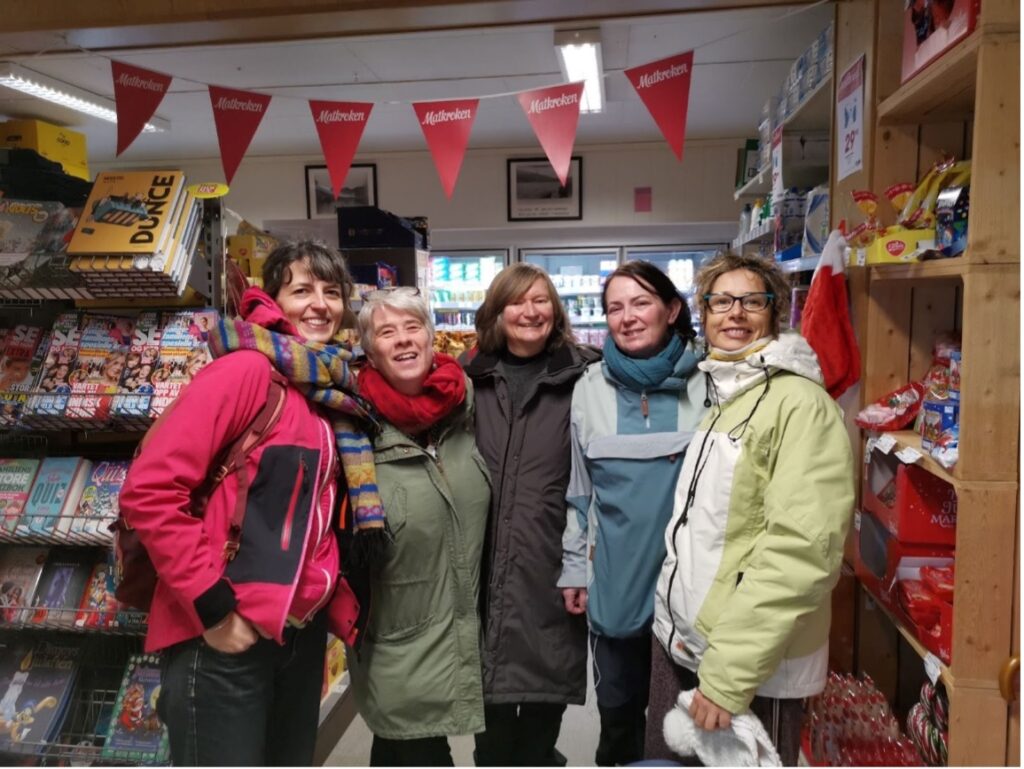
    We went to the local convenience store, from 1889, at the local quay, with its own bathing beach, established and maintained by voluntary workers and contributions from local traders. I have been on the Board of the store and know how hard we have been fighting to keep it, a fight against capitalism and centralisation. It’s a very important meeting place for our local community. It’s the heart of our village. 

    From left to right Gaia Del Negro, Berit Bareksten, Hazel Wright, Inger Helen Midtgård, and Silvia Luraschi in the local convenience store (Ph Ørjan Namdal, store manager).

    Then we went to the small youth house built in the 1930s. A cozy three-room hosting the Norwegian youth culture movement, Noregs Ungdomslag, one of the most important movements to build the Norwegian nation after 400 years under Danish supremacy. Walls full of memories from the community theatre show, myself, my sister and the rest of the big theatre family I belong to, for 30 years now. What if the walls could talk, of all the fun, the joy, the singing, dancing, and belonging and connecting they have been watching? Culture building and community building.

    I feel so proud to be a part of this building community movement embodying this love that I feel for my local community. Be- longing and belonging to something that really means so much to so many people.

    Maybe I have something to show them Nevertheless?  I start explaining about our local convenience store, It’s all connected you know. The store, the culture movement and the local people, part of the whole. Part of our lives. We have had a lot of battles to keep the local store. Nowadays the electric bill for the store is threatening us. Should this important meeting place close, because of EU and Acer, a store that has survived two world wars and the hard thirties? I started to cry, speechless because of the pain, the injustice and how bloody capitalism works.

    Looking at all the pictures telling their own stories (Ph: Berit Bareksten)

    Then to the other newly built culture house where I had my 50th birthday some years ago, celebrating with a big concert and with over 100 people, dancing, singing, eating and drinking together. I showed them the “Sandbergsalen” the tribute to the filmfamily from Bergen, with their cottage at Hjelmås who had documented the daily lives of local people for three generations with such warmth and love. Big photos of their films with local people at the walls. 

    I remember making a speech as leader of the local community council the day we  solemnly opened this hall: 

    “What unites a people? Armies? Gold? Banners?
    No.
    Stories. Nothing is more powerful than a good story. Nothing can stop her. No enemy can beat her. (..) The quote is from Game of Thrones (a film in a somewhat different genre than the Sandberg films) and are Tyrion Lanniser's words.
    It is the good stories that unite us. Three generations of the Sandberg family have shown us that. With their warm humour, warm portrayal, they have created lovely stories, attached them to the film and created something completely unique”. 

    Some years ago I collaborated with Øyvind Sandberg, in teaching, related to his ethical perspectives when doing his warm and wise filming, working with his authentic characters.  Yes I do really have something to show the others, I now see, driving home to make us a late dinner; taking Berit, Gaia, Silvia and Hazel to eat Bacalao in my house by the fjord where I have belonged for generations, joined by our good friend Bodil and sorry that Donata could not joins us until later.