Category: ESREA LHBN 2023 Research

Research contribution to the European Society for Research on the Education of Adults Life History and Biography Network
Meeting 2023 in Trondheim

  • Buddyscapes #1

    Buddyscapes #1

    Silvia Luraschi (Adult Educator & Independent researcher collaborator, University of Milano Bicocca) and
    Tom Troppe (PhD Student, Canterbury Christ Church University

    Buddyscapes documents a relationship which originated in the annual meeting of the Life History and Biography Network (LHBN) of the European Society for Research on the Education of Adults (ESREA) convened at the University of Lower Silesia at Wroclaw, Poland, 3-6 March 2022. This meeting was established as a ‘hybrid’ event: delegates could participate on-site or online. Following on the previous year’s event, which was limited to online participation due to the ongoing covid-19 pandemic, this hybridity opened up an opportunity for inquiry. Given that the theme of the conference was ‘Encountering the other: biographies, spaces and relationships in adult education,’ there was, perhaps, a heightened sensitivity to the possibility that the hybrid environment could potentially create such different experiences of the event as to become a kind of othering. An announcement was made at a break: onsite participants could be assigned a buddy from among online colleagues and vice versa. As we recall it, the objective was to help online delegates experience some of the conviviality we were experiencing in Wroclaw and, of course, to help those on-site to benefit from a fuller experience of online delegates’ presence. That evening at 20:16, I (Tom) received an email confirming that my buddy would be Silvia. My phone buzzed 5 minutes later, notification of my first message from her:

    Hi Tom, I’m Silvia from Milano (buddy system LHBN). Have a great Friday night in Poland!

    I responded the following morning with a photo of the art installation by Andrzej Jarodski (2010) outside my hotel:

    Good morning, Silvia! …this is the Train to Heaven.
    Train to Heaven by Andrzej Jarodski

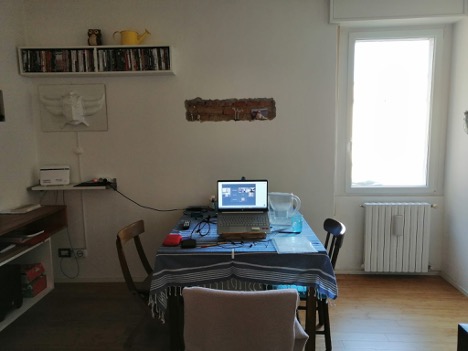
    Silvia called it a ‘great metaphor of our lives… Hopefully :)’ and replied by showed her working environment for the conference.

    Silvia’s working environment for the conference.

    While this buddy system was designed for the days of the conference, there was also the suggestion that it might continue beyond that if we wished. We have so wished, and have continued to share photos over the ensuing months. To date, we have shared messages on 96 of the 268 days between 4 March and 27 November, averaging about one every 3 days. These messages often include photographs, following the pattern established in these first exchanges. During this time, Silvia has shared 197 photos and Tom has shared 173, a quantifiable balance in the dialogue.

    As a public replication of this professional exchange, we would like to begin here a series of blog posts in which we share the traces of this dialogue and our interpretations of it, whilst extending to the Network an invitation to join us in this evolving role of buddies. In particular, given the focus of June’s network meeting, we are curious to discover how these images and their accompanying texts represent landscapes, timescapes, ‘e-scapes’, our belonging within and across them, and how this might shed light on our theory and practice as educators.

  • Walking an article – Part 2 

    Walking an article – Part 2 

    Berit Bareksten (sociologist at HVL, Western Norway University of Applied Sciences)

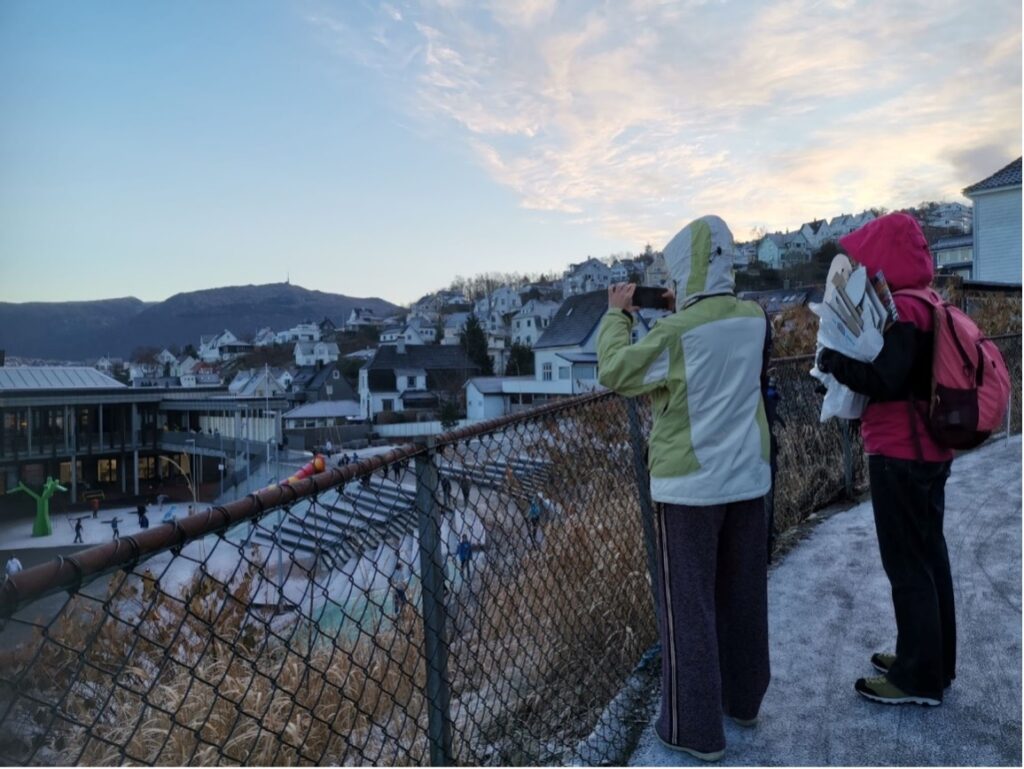
    I did a walk with them, through my neighborhood of belonging, in my well-known landscape of trust and joy. We stopped at the primary school with children playing outside with the first snow this winter. It was like they saw something they never had seen before. They took pictures of children in their playground. I stood there, looking at them. Smiling. Felt rich, them standing there, being here, in togetherness. I felt in place. Steady. I realized I was on my feet and back on track, thanks to the chapter about community work: (https://press.nordicopenaccess.no/index.php/noasp/catalog/view/168/897/7290).

    Silvia and Gaia looking at a primary school playground during the morning walk with Berit.

    I had to admit; I like to walk around in my neighborhood, although I do not know my neighbors so well these days. It has been too many losses throughout the last few years. I have been either in my bed – or at my desk, writing. Trying to find a new direction in my life. Or I think more precisely trying to concentrate on those practices that I always have done: Teaching, writing, planning, doing, sharing and collaborating with others. It’s like I have forgotten how to do it. It’s like time stopped after the house was taken away. She took her death from that not-existing-anymore house. The loss took her down. She was raised by the house, happy for the house, rich by the house, teared and frightened by the house. The house kept the family together. Not anymore. Not any longer. Has it ever been that house – for her beloved family. Why did I write that sentence, I ask myself. They took it down again, this next generation – her beloved children. It wasn’t worth all the struggles. She died with that in her mind.

    What profits a man if he gains the whole world, but loses his soul?

    The house that no longer exist (Ph Berit Bareksten)

    The voluntary library it’s just downhill here, I said. Asking them to come along. We went into this cold, old German-built house, from the days of the war in my neighborhood. I told them about these bunkers still there, now housing our local museum. All done voluntarily throughout many years of raising money and taking care of the buildings and their own local history. Felt proud nevertheless, I’m born and raised in another part of the country. Feet and roots here, in this landscape, with my beloved ones. Yes, felt free when I looked upon them taking pictures to keep memories. Taking them back home, to their landscape – shaping thoughts together. Continuing from the old house to the brand-new library with warm and willing walls of welcoming colors, books, and recycled materials. Beautiful memories of what will come here in the future. We retold the content from the chapter, the one that we had just walked through – pictures for memories. The librarian, a young man, put that picture back on the wall again.

    Berit is smiling in the new Laksevåg bibliotek (Ph Silvia Luraschi)

  • Walking an article – Part 1 – Kollektiv mobilisering

    Walking an article – Part 1 – Kollektiv mobilisering

    Gaia Del Negro & Silvia Luraschi (independent researchers collaborators at the University of Milano Bicocca)

    Two days ago, we (Gaia & Silvia) had the possibility to listen to our colleague Berit Bareksten telling us about her work for the local library in the neighborhood where she lives in Bergen. Berit walked us through a residential area called Laksevåg. We first entered a historical building from the Second World War, where a group of local mothers met for more than five years and co-organized cultural activities with readings and music for families and children. The building hosts the local scout groups, and the books in the room from the independent community library the women set up, is still there.

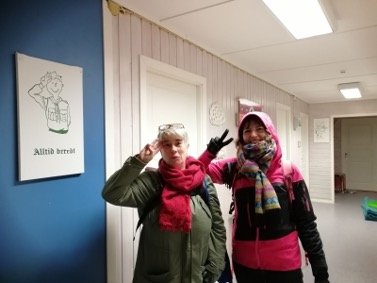
    Berit and Gaia discover they both were in the scouts as children (Ph Silvia Luraschi).

    We walked on through a park to the new library, a modern and functional structure with playful spaces for children to draw, read, and rest (https://bergenbibliotek.no/bibliotekene/laksevag-bydel/laksevag). The municipality opened the new library after pressure from the women’s group for locals to have a place to meet, read, and study.

    Gaia and Silvia look at children’s books in Norwegian (Ph Berit Bareksten).

    Here a new conversation took place between Berit and the librarian. Our friend told him the story of the collective struggle to create a community library in an area with no facilities for the people. The women (later joined by other citizens) organized performative actions, among which a parade with an actor dressed as the Book Warm. The parade had entered the room where the municipality then opened the library. The librarian was very happy to hear the story and found an old photo of the parade and promised to hang it up in the library.

    We walked back to the rest of the day with Berit smiling with satisfaction at the recognition of her and the women’s work for their community. We made up the expression: today, as we could not read your article in Norwegian, we walked the article!

  • Spanish Lessons by Peter Leyland

    Spanish Lessons by Peter Leyland

    Peter Leyland

    - Conjugate the verb hablar for the class

    I drew my gaze down from the ceiling to find myself the centre of silent attention. Mr Richards was addressing me, yes me, and a finger was pointing accusingly. Blushing I stood and, holding my orange text book awkwardly, began:

    - Hablo' -  habla's - habla' - habla'mos - habla'is - habla'n  

    There was a murmur of amusement from the class as I began to sit down.

    - No, you simpleton! What have I just been telling you!

    The Hurley stick flashed against the desk, beating a rhythm in time with the correct stress:

    - Ha'blo - ha'blas - ha'bla - habla'mos - hablai's - ha'blan! Say it again

    Now standing I repeated the conjugation, nervously placing the stress where the master required. As he spoke the Hurley stick rose and fell. 

    This is a remembered sequence from my first ever Spanish lesson, recalled during an international conference on adult education that I attended recently. The conference was taking place online and Emilio, one of the speakers, had told us that he was researching how people tried to rebuild their history after The Spanish Civil War when, following Franco’s death, democracy was restored in Spain. 

    From that rather violent beginning with Mr Richards at the age of 11, I had gone on to study Spanish at O’ and A’ level. This had taken place at The Liverpool Institute during the 1960s, yet never once had my teachers mentioned the civil war that had taken place in Spain. Nor, when we were 6th Formers and more aware, despite our entreaties had they ever mentioned that Franco, the architect of a war which included the infamous bombing of Guernica and which featured atrocities on both the Republican and Falangist sides, was still in power. After all, everyone was at this time going on wonderfully cheap holidays in sunny Spain. Those teachers with their Oxbridge degrees in Spanish Language and Literature couldn’t rock that boat for a group of recalcitrant Liverpudlian schoolboys. 

    Surprisingly perhaps, I retained a love of Spanish founded in such an unlovely setting at The ‘Inny’ as we called it. An early girlfriend gave me a book of Lorca’s poetry; I watched interpretations of Lorca’s plays like Blood Wedding and The House of Benarda Alba. I read Cervante’s Don Quijote and felt a deep identification with the knight who tilted at windmills, who had a faithful servant called Sancho Panza and who loved the impossible Ducinea del Toboso.

    And later on, when I was very much older and lived in a cottage in Cranfield, with a main  room which had a coal fire and a chimney that had to be swept annually, I watched the Granada TV/Channel 4 series The Spanish Civil War. Spaniards had begun to speak of the savage repression and political struggle that had taken place during Franco’s illegal overthrow of the Republican government in Spain. Beside the fire I read Arturo Barea’s three volume autobiography, The Forging of a Rebel, first published in English in 1941, which is a passionate memorial to his love for and experience of his country. In Pittsburg, part way through a Greyhound bus trip, I saw Picasso’s masterpiece, Guernica (now in Madrid), about the deliberate bombing of civilians in that town in 1937, and I stood transfixed. I had begun to see how the power of art and literature could transform our understanding of human suffering.

    But to return to Emilio. We were sitting in our online rooms and our conference was coming from Wroclaw in Poland. When it was Emilio’s turn to present, he spoke of how Spaniards lived, and still live, in a culture of silence about that time of war, because they have neither the means nor the ability to express their feelings about their own history. He described in halting but good English how he had collected histories of the civil war, by carrying out ten interviews, seven women and three men, all adult learners who had lived through it.

    One story that he recounted struck me forcibly. Maria, one of the female interviewees, had been recorded speaking of how her father was taken away by The Santiago el Tejero (the cross eyed) and never returned:

    It was August 10 [1936], my father was at the farmhouse with the goats, and he came to bring the milk. My mother went to take it to the shopkeeper, and my father remained at the door [of the house] with one of my sisters who had not still walking and my three year old brother playing with. Three men, two policemen and a Falangist got out and told him to go with them for asking some questions. My father gave me the girl and he sit me on the chair. When my mother arrived and asked about him people told her that some men had taken him away. My mother ran to see what went on, and she met a neighbour [who told her]: “Your husband was taken by Santiago, el Tejero, the cross eyed” My father never returned. 28 were shouted in the gate of the cemetery. It was August 12,1936. My mother had five children and she was also six months pregnant. The baby was born and he never met his father and died after 6 months (Maria A. Taller para la recuperacion de la memoria historica, 2007 p. 144)

    The memory sequence as I said came into my mind as I was participating in the online conference. As I write this now a week later, news of the war in Ukraine grows louder, and the plight of the people caught up in the atrocity of Putin’s invasion increases. During a conference break I had stepped out of the breakout room to write a haiku:

    Mothers and children
    Crushed against carriage windows
    Fathers wave goodbye

    Were our teachers in the 60s trying to protect us from the awfulness that men (and it is mostly men) are capable of? Was Emilio with his uncovering of painful memory providing some comfort to those who had lost loved ones in a long-ago conflict; and can we ever stop this recourse to war as the solution to seemingly intractable differences? Let me know what you think.

    This text was first published on Authors Electric

    • Notes:
    • Don Quixote Parts I and 2 (1605-13) by Miguel de Cervantes
    • The Forging of a Rebel (1943 trans. Ilsa Barea) (1951 – First Edition in Spanish) by Arturo Barea
    • The Spanish Civil War (1982) by David Mitchell, based on the television series
    • Selected Poems (1961) by Federico Garcia Lorca
    • The Age of Reason by Jean Paul Sartre (1961 Penguin translation cover)
    • Encountering the Other (2022): Activity Booklet designed by Dorota Kostowska
  • Moving between constraints and possibilities of belonging and outsiderness

    Moving between constraints and possibilities of belonging and outsiderness

    Antonella Cuppari (PhD Student, University of Milano-Bicocca)

    I have waited three years for that moment
    when I would take my last step to the top
    carried on my shoulders together with vertigo
    and now, looking up, only sky
    full not cut out
    and everything turns upside down again
    the end becomes beginning
    again I no longer know who I am anymore.
    (My poem, “The End of a PhD path”)
    “The unpredictable is a value that must never be renounced,  emptiness must be welcomed and loved, to be amazed by reality is supremely energetic and therefore to be amazed it is necessary to be open to the unexpected, to be, within reality, a stranger.”
    Mariangela Gualtieri

    Inspired (in an irriverent way) by the multiplicative possibilities of meaning offered by duoetnography (Sawyer & Norris, 2013), I tried to relate two texts: on the one hand, a poem I wrote a few days ago in which I felt the need to give voice to my experience as a still-briefly-doctoral-student and, on the other hand, a thought by an Italian poet I love very much, Mariangela Gualtieri, who invites us to confront the unexpected as a stranger in reality.
    These different positionings make me wonder about the theme of belonging and outsideerness. Soon I will no longer be affiliated with the university and, at the same time, this workplace doctorate has changed the relationship with my colleagues and the organisation in which I work, in a way that I cannot fully understand today. During my three years as a PhD student, I experienced belonging and outsiderness in my relationship with both contexts and this allowed me to find a fluid and moving posture, despite the discomfort (Cuppari, 2022). Today, one of two contexts of this belonging is no longer taken for granted and I suddenly feel disoriented. A sense of alienation predominates, also in relation to the impossibility of accessing certain services and opportunities when I stop being a doctoral student. The outsiderness and disorientation generated by not belonging deeply questions my identity (“I no longer know who I am anymore”).
    These brief considerations on belonging question me. In my life as a student, belonging has guaranteed me access to rights and opportunities that I feel are being lost today. However, in other experiences it can also become a constraint when it risks becoming a prejudice, a stereotype and a social category that excludes, as in the case of a person with a disability, for example, which is the topic of my thesis.
    The evocative dialogue between the poet Gualtieri and myself questions belonging in its aspects of constraint and possibility and in its generative relationship with the complementary dimension, that of outsiderness.
    I finish by proposing the listening of a track and the words that accompanies it.